Kari launches blueprint to fix kenya’s sick soils
To counter the problem of the country’s infertile soil - depleted over years by poor farming techniques and now yielding one-third of the global average - the Kenya Agricultural Research Institute is promoting a blueprint to put deficient nutrients back into soil, with warnings that it may take 30 years to fix Kenya’s sick soil.
Dr Catherine Kibunja, a soil specialist at KARI, said the soil fertility blueprint was a long-term project, and might take over 30 years to bring the soil to fertility and peak production. The KARI programme is also urging fertiliser companies to blend new types of fertiliser containing badly needed, scarce micro nutrients.
The Alliance for Green Revolution Africa (AGRA) in 2008 also embarked on a 10 year soil health improvement initiative around Africa, which it projects will raise yields by up to 130 per cent in some countries. Like KARI’s plan, its programme combines using inorganic methods, like fertilizers, and natural organic methods, like intercropping and composting.
The AGRA initiative aims to regenerate 6.3m hectares of land to benefit 4m rural house holds. According to a 2006 report by the International Fertilizer Development Centre (IFDC), African land is 75 per cent degraded resulting in low, stagnant yields, deficient of vital minerals and nutrients such zinc, iron and manganese in the food crops.
These deficiencies are also having a knock-on impact on human health, weakening immune systems and contributing to lifestyle diseases.
At the same time, the grain yield in Africa is 1 tonne a hectare compared to the world average of 3 tonnes. “Our soils are sick,” said Dr Kibunja, who attributes the problem to reduced organic matter in soils to hold the nutrients.
The KARI methods increase soil fertility by using fertilizers classified as inorganic together with compost waste from harvests, classified as organic or green manure. The methods are complemented by farming techniques like crop rotation, which breaks disease cycles, and intercropping, which loosens soil and adds more nutrients to it.
Like other farmers in Africa, Kenyan farmers lack knowledge on the importance of replacing the nutrients lost from the soils after harvests. According to Dr Kibunja, the problem is exacerbated by common after-harvest practices, like burning remnants such as dry stalks or feeding them to animals.
The burning is the worst form of soil degradation, said Dr Kibunja. Once carbon organic matter (humus) holding soil nutrients goes up in smoke, “we lose the nutrients, it’s like burning a bag of fertilizer”. Yet this is a widespread practice in Kenya.
Another key problem is what Dr Kibunja calls “export of nutrients”, which occurs mainly when the nutrients used by crops to grow are not replaced, for instance when nothing is done to replenish the nutrient uptake by maize from when it’s a single seed to a mature maize cob.
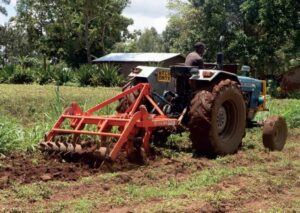
KARI’s soil fertility plan, the Integrated Soil Fertility Management (ISFM), encourages farmers with dry stalk, organic matter like cobs, and dry leaves to leave them to decompose in farms rather than burn or remove them. Even in land preparation, the dry matter is better ploughed or furrowed into soil to add to the vital organic carbon matter.
In addition, during every planting season farmers are advised to put in more than double the nutritive farm inputs to replace the ones diminished in the previous harvest. The surplus nutrients are retained in the soil. “It’s like a savings account,” said Dr Kibunja.
Though maligned by organic farming proponents, fertilizers are becoming integral to rehabilitating depleted African soils. The soils are lacking vital micro nutrients that are critical to getting higher yields. These according to Dr Kibunja play a similar role medicine plays in convalescents and need to be used in tandem with organic methods.
According to KARI studies, when both organic and inorganic methods are applied to a hectare piece of land it can yield twice as much as when either method is used independently, with continual replenishment of soil nutrients reflected in rising yields after every season. This can see grain yields rise from just 1 tonner per hectare as high as 14 tonnes per hectare, as in Zimbabwe.
Some of the rare micronutrients lacking in soils and fertilizers are iron, boron, zinc, manganese and chlorine and it is these that KARI is urging fertilizer companies to increase in their new blends. Though needed in low quantities in crops their lack results in stunted growth and nutrient deficiency passed on to consumers – teh resulting crops just are not as healthy to eat.
The Agricultural Ministry through their extension officers will perform a soil analysis for farmers for around Sh1000 to establish which nutrients need adding. For instance, in Embu soils with high acidity have been found to have poor root penetration, meaning farmers are now adding lime to improve the soil quality.
ISFM is also promoting crops that add nutrients to the soil without taking much away. These include legumes known to add nitrogen to the soil and cover crops, like sweet potatoes and mulch, which aid in conserving soil moisture and add organic nutrients.
James Karuga for African Laughter
Newer news items:
- Global partners move to create African soil map - 04/05/2012 09:31
- Microdosing increases yields on infertile soils - 23/04/2012 12:41
- Farmers discover cost cutting liquid fertilizer - 01/03/2012 12:00
- Farmers turn to 'fertiliser tree' to boost crop production - 01/03/2012 11:16
- Farmers find a cheap,environmental friendly alternative to fertilizer in waste products - 01/03/2012 10:59
Older news items:
|
|
|